admin@bhaskarnewspaper.com
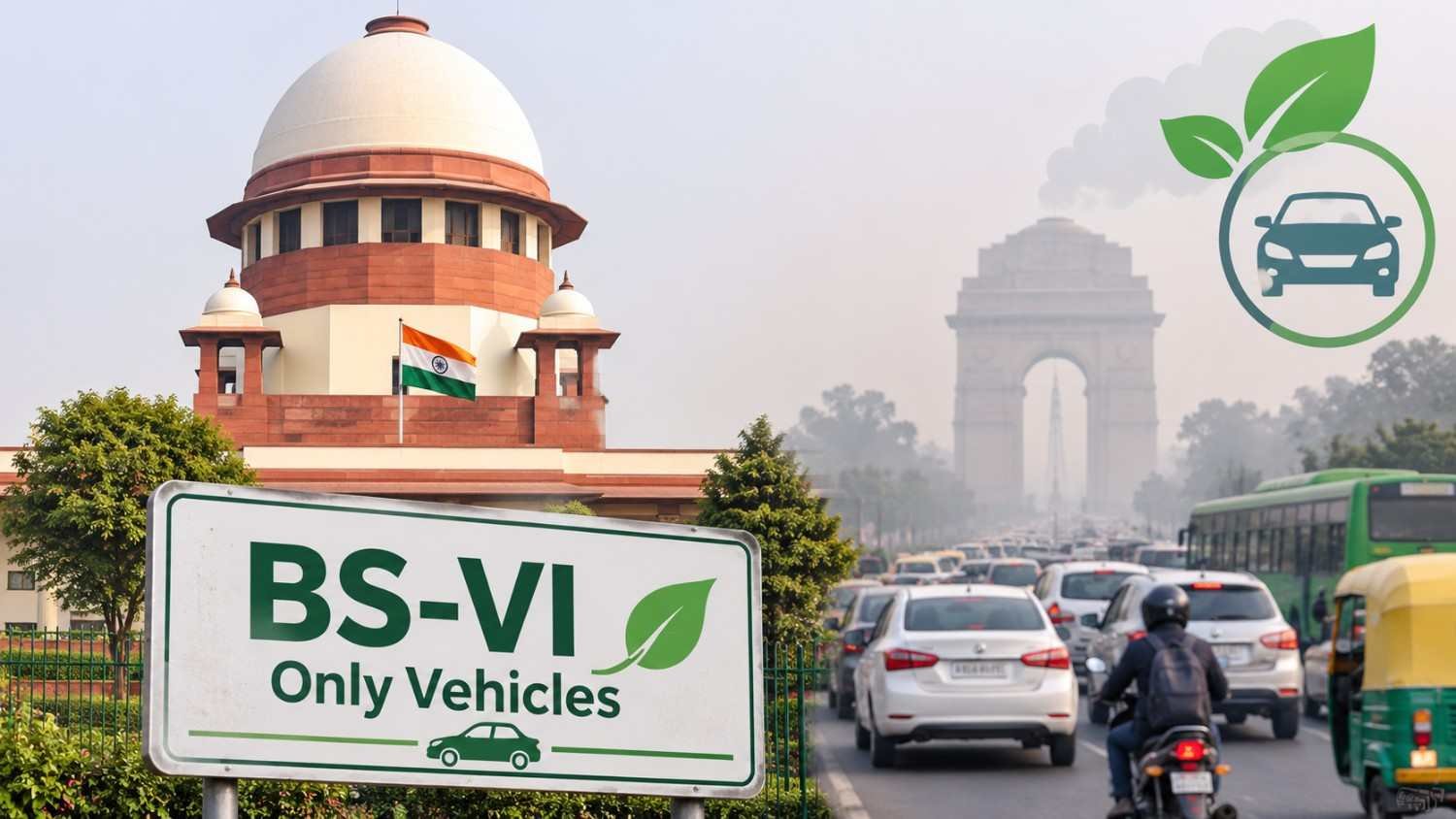
The Supreme Court has expressed support for allowing only vehicles meeting BS-VI emission standards to operate in Delhi during the winter months. The move is aimed at reducing vehicular pollution, which is one of the major contributors to poor air quality in Delhi-NCR.
During a hearing on November 23, 2026, the court said it wanted only BS-VI-compliant vehicles in Delhi and indicated that the restriction could also be considered for the wider National Capital Region (NCR).
The observation came as the court examined measures to tackle Delhi’s recurring winter pollution problem. The hearing was conducted by a bench headed by Chief Justice of India Surya Kant, along with Justices Joymalya Bagchi and V Mohana. India Today+2
Supreme Court Supports BS-VI-Only Vehicles During Winter
During the hearing, Justice Joymalya Bagchi made the court’s position clear, saying that only vehicles meeting BS-VI emission standards should be allowed in Delhi, and possibly across the NCR.
The court’s observation came amid concerns about older vehicles and the difficulties some BS-IV vehicle owners reportedly faced in obtaining Pollution Under Control (PUC) certificates.
A lawyer informed the court that some vehicle owners were facing problems because PUC tests for certain BS-IV vehicles were allegedly not being conducted. The issue had also reportedly created difficulties for some owners in getting fuel.
The court discussed the need for stronger restrictions to control emissions from vehicles during the winter season.
However, the remarks should be understood as the court’s position during the hearing, not as confirmation that a new blanket ban on all BS-IV vehicles registered in Delhi has already come into force. India Today+1
What Are BS-VI Emission Standards?
BS-VI stands for Bharat Stage-VI. These are vehicle emission standards introduced in India to reduce harmful pollutants released by petrol and diesel vehicles.
The standards set limits on emissions such as nitrogen oxides, particulate matter and other pollutants.
BS-VI vehicles use improved emission-control technology compared with older BS-IV vehicles. This helps reduce the amount of harmful pollution released into the air.
The transition to BS-VI standards was an important step in India’s efforts to improve vehicle-related air quality.
What Are the Existing Vehicle Restrictions in Delhi?
Delhi has already introduced restrictions on the entry of certain vehicles from outside the national capital during the winter pollution season.
Under the current winter restrictions, non-BS-VI petrol and diesel vehicles registered outside Delhi have been barred from entering the city from November 1, 2026, to January 31, 2027, subject to applicable exemptions.
The restriction particularly affects vehicles coming from neighbouring NCR areas such as Gurugram, Noida, Ghaziabad and Faridabad.
The government has also said that the winter restriction will be an annual measure. CNG and electric vehicles, along with specified exempted categories, are treated differently under the applicable rules.
The exact conditions depend on the vehicle category, registration location and exemptions mentioned in the government’s notification. The Times of India+2
Will BS-IV Vehicles Be Banned in Delhi?
The Supreme Court’s remarks have raised concerns among owners of BS-IV and older vehicles. However, it is important to distinguish between the court’s observations and an enforceable order.
The court indicated that it favoured a BS-VI-only approach during winter. But the November 23 hearing did not itself establish a new blanket prohibition covering every BS-IV vehicle registered in Delhi.
The existing winter entry restrictions for vehicles registered outside Delhi continue to be relevant. Vehicle owners should check the latest government notifications and applicable exemptions before travelling.
The Supreme Court is examining whether stronger restrictions are needed to address the pollution problem in the capital and surrounding areas. India Today+2
Supreme Court Discusses Five-Year Plan to Keep Heavy Commercial Vehicles Out
The hearing also focused on the role of heavy commercial vehicles in Delhi’s air pollution.
The Chief Justice suggested that authorities should work towards a system in which heavy commercial vehicles do not need to enter Delhi over the next five years.
The court discussed setting up warehouses and storage facilities near Delhi’s borders. Under this proposed arrangement, trucks could unload goods at these facilities, and smaller battery-operated or other less-polluting vehicles could transport the goods into the city.
The idea is to reduce emissions from heavy vehicles while ensuring that Delhi continues to receive essential supplies.
The court also recognised that an immediate and complete restriction could create difficulties because residents depend on regular supplies of vegetables, fruits, food and other daily necessities.
The five-year plan was discussed as a possible long-term approach. It should not be treated as an implemented policy or an immediate ban on all commercial vehicles. India Today+2
Supreme Court Seeks Action from Delhi-NCR States
The Supreme Court also stressed that Delhi’s pollution problem cannot be addressed by the national capital alone.
The bench questioned the role of neighbouring states and called for stronger cooperation between Delhi, Haryana, Punjab, Uttar Pradesh and Rajasthan.
The court directed the Advocates General of these states to appear in the proceedings and sought detailed reports explaining the steps being taken to control air pollution.
The reports are expected to help the court assess the measures already implemented and identify areas where additional action may be required.
The court also questioned the Municipal Corporation of Delhi over the pollution-control measures presented before it and asked authorities to provide detailed information through affidavits. India Today+1
Why Is Vehicular Pollution a Major Concern in Delhi?
Delhi experiences a serious air pollution problem during the winter months. Low wind speeds, changing weather conditions and temperature-related atmospheric effects can cause pollutants to remain close to the ground.
Vehicle emissions add to this pollution burden. Cars, buses, trucks and other vehicles release pollutants that affect air quality and public health.
According to figures cited in the Supreme Court proceedings and reported by the Hindustan Times, transport within Delhi accounted for around 21.5% of the city’s PM2.5 pollution on November 23. The same estimates indicated that a substantial share of particulate pollution came from outside Delhi, highlighting the need for coordinated action across the region. India News
This is why the court is looking beyond individual vehicle restrictions and discussing wider measures involving public transport, commercial vehicles and neighbouring states.
What Should Vehicle Owners Do Now?
Vehicle owners should not make decisions based only on the court’s oral observations.
People travelling to Delhi from NCR cities should check whether their vehicles meet the emission standards required under the current entry restrictions.
Owners should also:
- Check their vehicle’s Bharat Stage emission category.
- Keep their Pollution Under Control certificate valid where required.
- Review the latest Delhi government and transport department notifications.
- Check applicable exemptions for CNG, electric and other specified vehicles.
- Confirm the latest restrictions before entering Delhi during the winter season.
A BS-IV vehicle registered outside Delhi may be affected by the existing winter entry restrictions even if it has a valid PUC certificate. A valid PUC certificate does not automatically override a separate entry restriction based on emission standards.
What Happens Next?
The Supreme Court is examining additional short-term and long-term measures to control air pollution in Delhi-NCR.
The court has sought reports from the neighbouring states and will consider what further directions may be necessary after reviewing the information.
The possible BS-VI-only approach and the proposed five-year plan for commercial vehicles indicate that the court is considering a broader strategy to reduce transport-related pollution.
For now, vehicle owners should follow the restrictions already notified by the authorities and wait for any further formal directions.
Frequently Asked Questions (FAQs)
1. Has the Supreme Court banned all BS-IV vehicles in Delhi?
The Supreme Court has expressed support for allowing only BS-VI vehicles in Delhi during winter. However, its November 23 remarks should not be treated as a new blanket ban on every BS-IV vehicle registered in Delhi.
2. When did Delhi’s existing BS-VI entry restriction begin?
The current winter entry restriction for specified non-BS-VI petrol and diesel vehicles registered outside Delhi began on November 1, 2026, and is scheduled to continue until January 31, 2027, subject to applicable exemptions.
3. Are BS-VI vehicles allowed in Delhi?
BS-VI-compliant vehicles are allowed under the current winter entry framework, subject to other applicable traffic and vehicle rules.
4. Can BS-IV vehicles from Noida or Gurugram enter Delhi?
The current winter restrictions bar specified non-BS-VI petrol and diesel vehicles registered outside Delhi. Owners should check the vehicle category and applicable exemptions before entering.
5. Why does the Supreme Court want only BS-VI vehicles in Delhi?
The court is concerned about vehicular emissions and their contribution to Delhi-NCR’s winter air pollution. BS-VI standards impose stricter emission limits than older standards.
6. Will heavy commercial vehicles be completely banned from Delhi?
The court discussed a possible five-year plan to keep heavy commercial vehicles out of Delhi by using border warehouses and cleaner vehicles for deliveries. This is a proposal under consideration, not an immediate implemented ban.
7. Which states have been asked to submit pollution-control reports?
The Supreme Court sought reports from Delhi, Haryana, Punjab, Uttar Pradesh and Rajasthan on the measures being taken to control air pollution.