admin@bhaskarnewspaper.com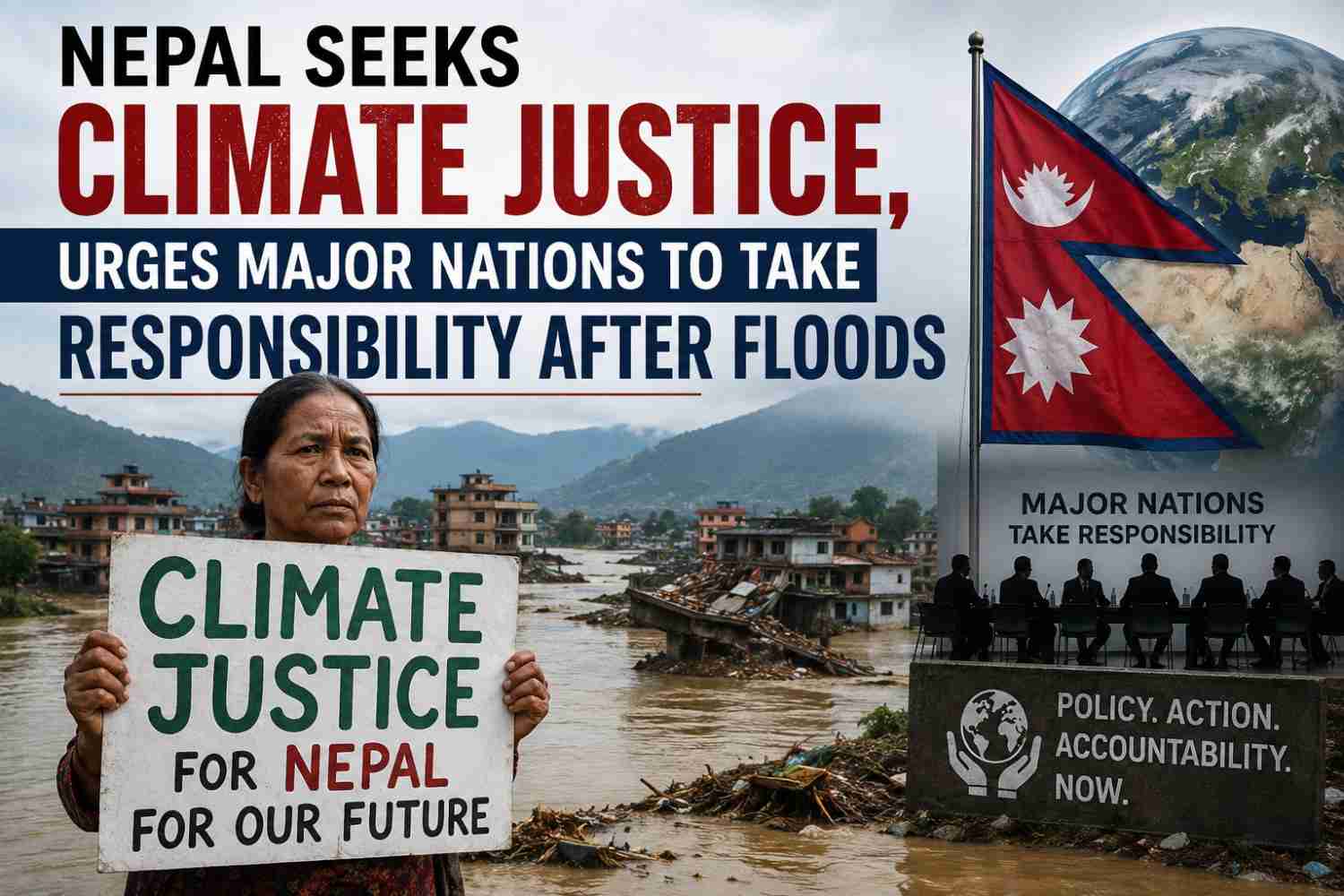
KATHMANDU — Following catastrophic flash floods that reportedly claimed more than 1,100 lives and left thousands missing, Nepal has stepped up diplomatic efforts to demand climate justice and financial support from major greenhouse gas emitters.
Officials in Kathmandu say the Himalayan nation is shifting its approach from relying primarily on post-disaster humanitarian assistance toward seeking greater legal, financial, and moral accountability from countries responsible for a significant share of global emissions.
“We are paying the ultimate price for a global crisis we did not create,” Nepal’s Foreign Minister Shisir Khanal said in a recent address. He argued that the rapid retreat of Himalayan glaciers and increasingly severe mountain disasters are closely linked to global climate change.
From Humanitarian Aid to Accountability
Nepal accounts for less than 0.1% of global greenhouse gas emissions. However, the Hindu Kush Himalaya region is warming rapidly, placing glaciers, glacial lakes, rivers, and mountain communities under growing pressure.
The devastating floods, which affected areas along the Bhotekoshi and Trishuli river corridors, reportedly destroyed villages, hydropower infrastructure, roads, and other critical assets. Finance Minister Swarnim Wagle estimated that early recovery and reconstruction could cost between $4 billion and $5 billion, equivalent to around 10% of Nepal’s GDP.
In response, Nepal has reportedly approached the United Nations-backed Fund for Responding to Loss and Damage, seeking emergency financial assistance rather than waiting for scheduled administrative proceedings later in the year.
Nepal Calls on Major Emitters
Khanal specifically pointed to China, the United States, and India, arguing that major emitters have a responsibility to help climate-vulnerable developing countries cope with increasingly severe climate-related disasters.
“This is a matter of civilisational survival,” Khanal warned, highlighting concerns over Himalayan glacier loss and its potential impact on water and energy security for more than two billion people across South Asia.
Nepal’s position also reflects broader debates over climate responsibility and financial support:
- The Global South’s Challenge: Mountainous and island nations argue that existing climate adaptation funding is insufficient to address sudden and devastating climate-related disasters.
- The Principle of Equity: Developing countries continue to emphasize “common but differentiated responsibilities,” arguing that historical emissions and differences in per-capita emissions must be considered when assigning climate responsibilities.
Taking the Issue to Global Forums
International assistance, including search-and-rescue support, bridge-building materials, and relief supplies, has reached Nepal following the disaster. However, Kathmandu maintains that temporary relief cannot substitute for long-term financial mechanisms to address climate-related losses and damages.
Nepal is now preparing to take its concerns to international forums, including the United Nations General Assembly in New York, where it plans to push for stronger financial commitments from major emitters and faster mechanisms to support vulnerable mountain ecosystems facing the consequences of climate change.