admin@bhaskarnewspaper.com
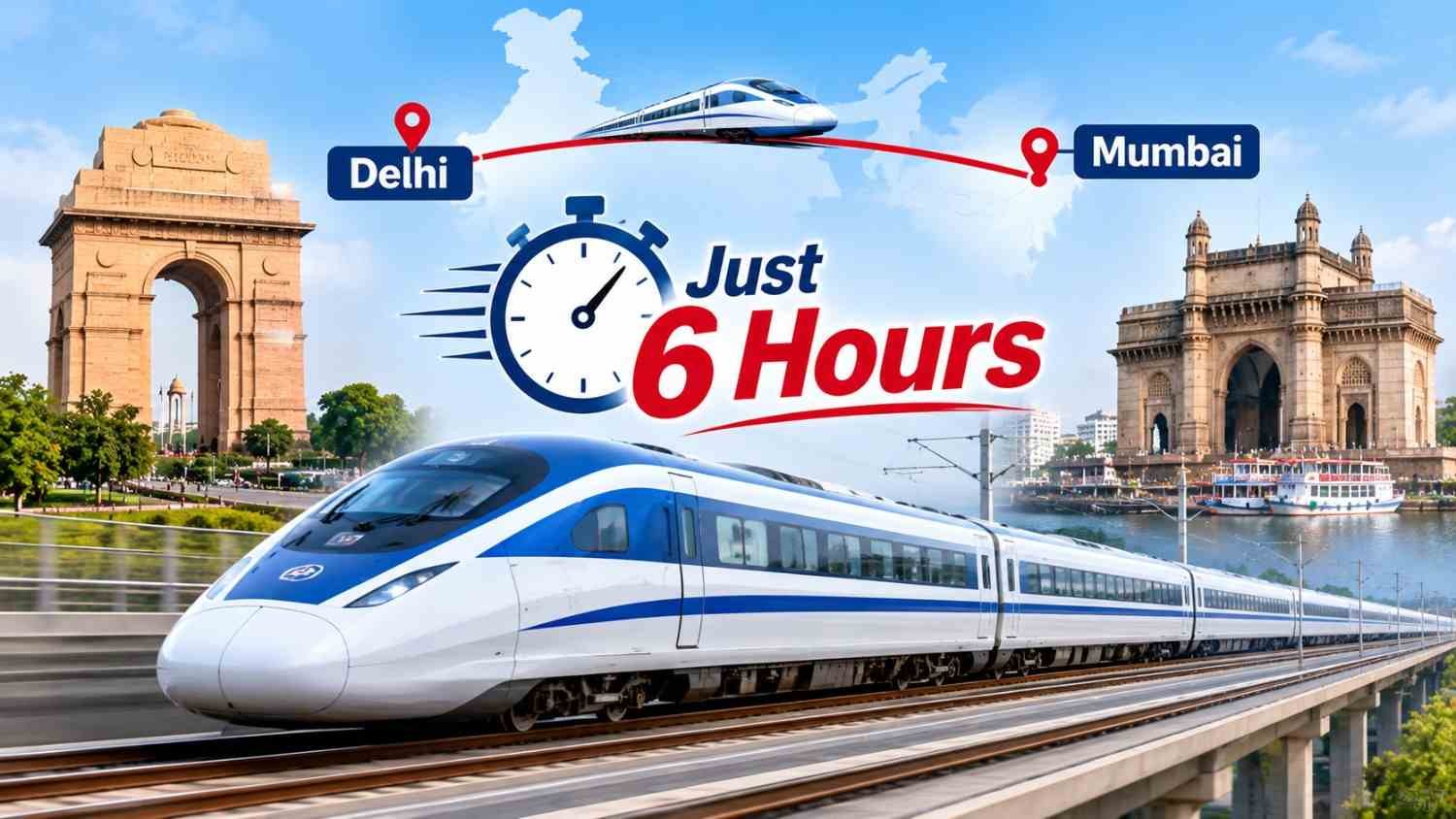
New Delhi, November 28, 2026: Travelling between Delhi and Mumbai could become significantly faster if India’s proposed high-speed rail corridors are eventually connected. The Delhi–Mumbai bullet train journey could take less than six hours, compared with approximately 15 hours and 40 minutes on the fastest conventional train connecting the two cities.
The proposed connectivity would depend on integrating the Delhi–Ahmedabad high-speed rail corridor with the under-construction Mumbai–Ahmedabad bullet train project.
However, the six-hour journey remains a long-term possibility rather than an officially announced travel-time target.
Delhi–Mumbai Bullet Train: Proposed High-Speed Rail Network
The proposed high-speed rail network would connect Delhi and Mumbai through Ahmedabad, improving passenger connectivity across northern and western India.
The network would consist of two separate corridors:
- Delhi–Ahmedabad High-Speed Rail Corridor: Approximately 886 km, currently awaiting project approval.
- Mumbai–Ahmedabad High-Speed Rail Corridor: Approximately 508 km, currently under construction.
Together, these corridors could establish a high-speed railway network spanning nearly 1,400 km.
Delhi–Ahmedabad Bullet Train Route and Proposed Stations
The National High Speed Rail Corporation Limited (NHSRCL) has prepared a Detailed Project Report (DPR) for the proposed Delhi–Ahmedabad corridor.
The proposed route includes 15 stations across Delhi, Haryana, Rajasthan and Gujarat.
Delhi
- Dwarka
Haryana
- IMT Manesar
- Rewari
Rajasthan
- Behror
- Shahpura
- Jaipur
- Ajmer
- Vijaynagar
- Bhilwara
- Chittorgarh
- Udaipur
- Dungarpur
Gujarat
- Himmatnagar
- Gandhinagar
- Ahmedabad
The proposed corridor is expected to feature elevated railway infrastructure, with its alignment designed to minimise private land acquisition.
Delhi–Mumbai Bullet Train Travel Time
The integration of both high-speed rail corridors could substantially reduce travelling time between major metropolitan cities.
| Route | Estimated Travel Time |
|---|---|
| Delhi–Ahmedabad Bullet Train | Less than 4 hours |
| Ahmedabad–Mumbai Bullet Train | Approximately 2 hours |
| Delhi–Mumbai Bullet Train | Potentially under 6 hours |
| Delhi–Mumbai Conventional Train | Approximately 15 hours and 40 minutes |
Actual journey times would depend on train speeds, station stops, operational arrangements and the integration of both corridors.
Mumbai–Ahmedabad Bullet Train Project Progress
India’s first sanctioned high-speed rail project, the Mumbai–Ahmedabad bullet train corridor, is currently under construction with technical and financial assistance from Japan.
The 508-km corridor will feature 12 stations, with trains designed to operate at speeds of up to 320 kmph.
The first operational section between Surat and Vapi is targeted to begin services in 2027, subject to construction progress and operational readiness.
Delhi–Ahmedabad Corridor Still Awaits Government Approval
Despite the preparation of its Detailed Project Report, the Delhi–Ahmedabad bullet train corridor has not received formal project sanction.
The corridor was also not included among the seven new high-speed rail routes announced in the Union Budget 2026–27.
Before construction can begin, the project will require government approvals, financial arrangements, feasibility assessments and land acquisition.
Its absence from the latest announcements does not necessarily mean that the proposal has been abandoned.
High-Speed Rail Network Could Boost Economic Growth
A connected Delhi–Mumbai high-speed rail network could improve access to major commercial, industrial and tourism centres across northern and western India.
Faster railway connectivity could benefit business travellers, promote domestic tourism, improve regional mobility and create new opportunities for investment.
The proposed network could also offer passengers an alternative to conventional railway services and domestic flights.
When Will the Delhi–Mumbai Bullet Train Start?
The government has not announced an official launch date for a direct Delhi–Mumbai bullet train service.
While construction of the Mumbai–Ahmedabad corridor is progressing, the Delhi–Ahmedabad section remains in the planning stage.
The possibility of travelling between Delhi and Mumbai in six hours will depend on the approval, funding, construction and successful integration of both high-speed rail corridors.